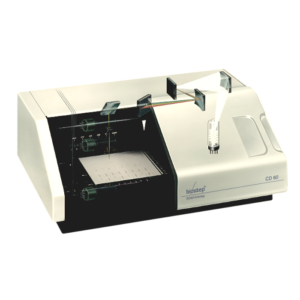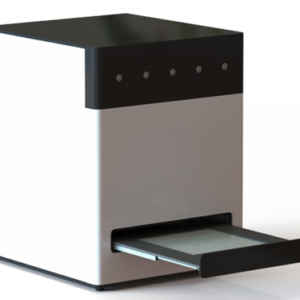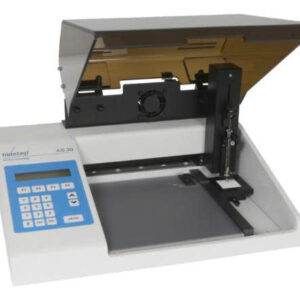


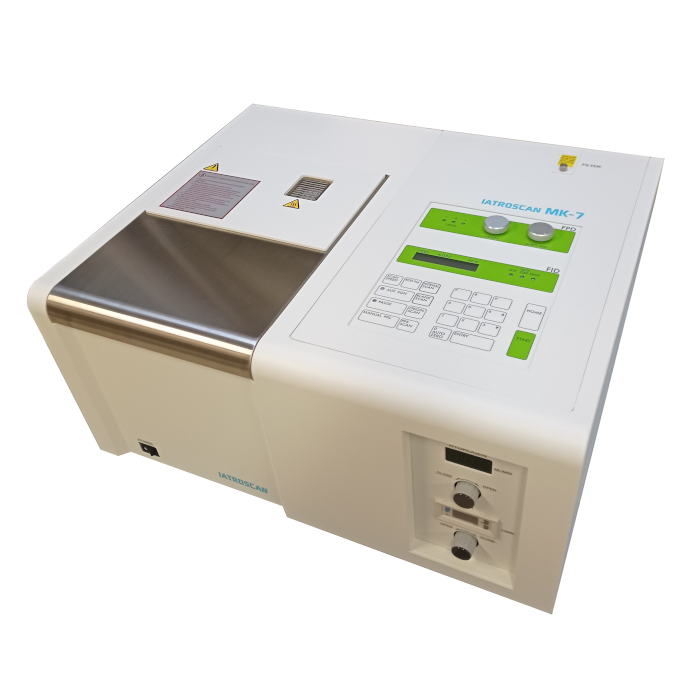
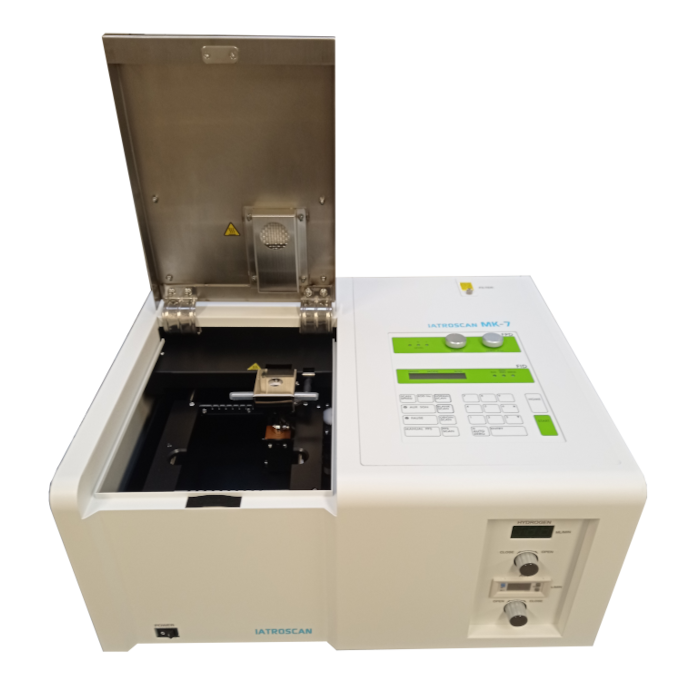
Iatroscan MK7s HPTLC/FID
The Iatroscan MK7s HPTLC/FID is the clever combination of two complementary technologies:
- Migration on HPTLC quartz rods
- Detection by FID electrode
This ingenious approach allows the Iatroscan MK7s to reliably address the challenges encountered in the characterization of certain non-volatile substances or those without UV absorption.
The main advantages of the Iatroscan MK7s FID system are as follows:
- Possibility to work simultaneously on 10 Chromarods
- Numerous fields of application
- Chromarods are reusable more than 50 times
- 20-30 minutes analysis time on average (depending on the method)
The most complicated samples can be qualified and quantified simply, quickly and economically, without the risk of column clogging and without the measurement uncertainty linked to the low UV reflection of certain substances.
The Iatroscan MK-7s HPTLC/FID analytical system can be used in many fields of application such as plant breeding, forestry, fisheries, the crude oil and carbon industry, the biochemical industry, biotechnology, the pharmaceutical industry, environmental pollution, the food industry, etc…
The Iatroscan MK7s can operate using Azur software, or be controlled directly from your HPLC or GC software*.
Principle:
Samples deposited on quartz rods coated with micro-particle size silica, called Chromarods or S-microcolumns, are eluted with aqueous or organic solvents.
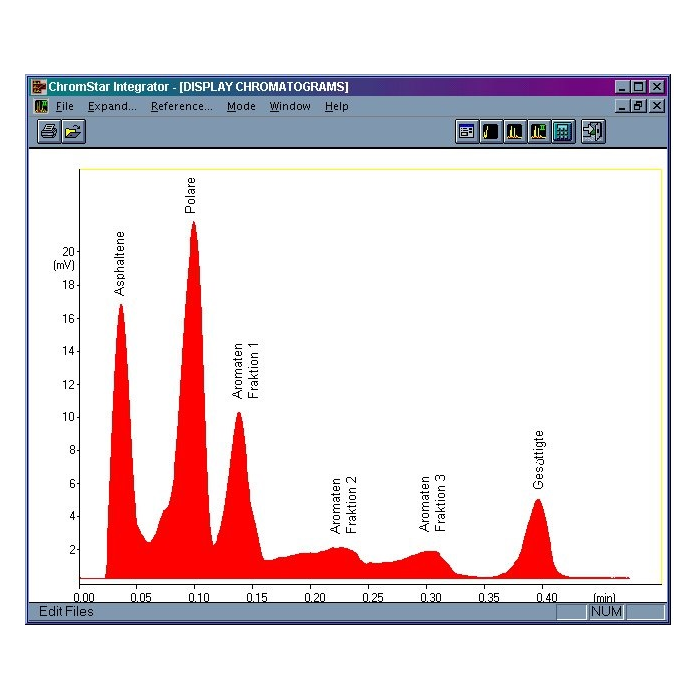
The separated components are detected by a flame ionization detector (FID), then identified and quantified. The Iatroscan MK7s makes it possible to separate, identify and quantify samples of a few nanograms.

Operation in 5 steps:
1-Activation of Chromarods
Press the Blank Scan key to clean and reactivate the CHROMARODs by passing them through the hydrogen burner flame. Each Chromarod can be reused 50 times, or more, giving the set a potential of 500 analyses.
2-Sample deposition
Deposit approximately 1µl of sample onto each Chromarod using a microdispenser or an automated system. Deposition can be partially or fully automated. See the “accessories” section.
3-Separation
Install the Chromarods in the analysis chamber. The components are separated on the Chromarods by elution according to the recommended procedure.
4-Solvent elimination
When development is complete, insert the rack into the dedicated drying oven to remove the solvent adsorbed by the Chromarods. The drying chamber is adapted to the frame format for rapid drying. A slight overpressure prevents dust from entering the chamber.
5-Measurement
Once the solvent has been removed from the Chromarods, place the rack into the Iatroscan measurement chamber and press Start to begin the process. The measurement is carried out according to the parameters entered in the menu. The analysis time for each Chromarod is between 25 sec and 60 sec. It is set by the operator when establishing the menu.
Chromatography on quartz rods… the Chromarod:
The chromatographic support called Chromarod or S-microcolumn is a 1 mm diameter quartz rod coated with a 75µm thick film of SiO2 phase with fine particle size: 3-5 µm combined with an inorganic binder.
Chromarods provide excellent separations with good repeatability.
Depending on the type of components to be separated, Chromarods can be “prepared” by first immersing them in baths. For example, to obtain an excellent separation of triglycerides according to their degree of unsaturation or of glyceride isomers, they can be soaked in a silver nitrate solution or a boric acid solution, respectively.
Partial burning… a specificity of the Iatroscan:
The method consists of separating all the constituents of a mixture using a cocktail of eluents of different polarities.
Initially, an eluent of polarity A is used which will carry along some of the molecules while the rest of the sample does not move or moves little from the deposit. The part of the support containing the molecules that migrated is burned. Their quantification is obtained, and the results are automatically stored in memory.
The preserved (unburned) part of the sample is then eluted with an eluent of polarity B to separate the other molecules, etc… as many times as necessary. After using the last eluent in the cocktail, the chromarods are burned along their entire length, including what remains at the deposit.
At each step, the results are associated with the previous ones. For each sample, a complete chromatogram of all molecules, from polar to non-polar, is finally obtained. This technique, which uses a single support and identical detection for each sample, allows obtaining comparative percentages between molecules of the same sample and between different samples, with the FID detection having the advantage of providing a linear response over a very wide range as a function of concentration.